
About the author

Showing posts with label politicians. Show all posts
None of the above: why it’s a good idea
 |
| My own take on a real ballot paper. (You can find it full-size on the Facebook page) |
Turnout in May 2014 local council elections: 35.7%
Turnout in London Mayoral elections 2012: 31.0%
Turnout in UK Parliamentary elections 2010: 65.1%
(Courtesy of electoralcommission.org)
Turnout in 2013 Australian general election: 93.23% (usually
fluctuates between 96% and 93%)
And yet they call us a ‘representative democracy’. From the
figures we see above, the government is currently only representative of 65.1%
of the public (I personally believe it’s representative of 0% of the public,
considering no one voted for a coalition, but that’s another blog…), with local
councils being even worse. However this is not wholly their fault, in fact the
worst part is it’s technically the fault of the public – officials in power
simply capitalise on whatever support they get, and take it as their
sovereignty.
It is unfair to compare turnout rates in the UK to turnout
rates in Australia, predominantly due to Australia’s system of compulsory
voting; if you don’t vote you are asked to give a reason why, and if the reason
is deemed insufficient you may be fined up to $170 – quite a good way to whip
people into voting. However the most important part of this system of voting is
the inclusion of a ‘none of the above’ option. This gives the public who are
not enticed by any party standing in the election, or those who are adverse to
the concept of sovereign rule completely to express their views without having
to spoil their ballots, protest vote, or simply not turn up.
The inclusion of both compulsory voting and the ‘none of the
above’ option would increase participation in elections in the UK
substantially, and hopefully (as a by-product) increase interest and knowledge
in politics. Most importantly, it would make our democracy that we clutch so
dearly to work slightly better – no longer would people who hadn’t turned out
to vote, yet still insist on critiquing the government because of stories they’ve
heard from the media of which they actually have no idea about, be accused by
people like me of having invalid arguments because they didn’t actually try to
impact the election that put the government they so hate into power in the
first place. (Of course, people like me would still accuse them of having
little knowledge of the things they are pretending to be experts in, thus their
arguments remain invalid, but hopefully having compulsory voting might entice
people to actually take an active interest in politics). And governments might
actually be able to call themselves sovereign, or accountable, due to the
almost total participation of everyone making a decision on what they want.
However, I would take the ‘none of the above’ option
slightly further, and treat it as if it were an actual candidate. If the option
has the most support in a constituency (in a general election), that
constituency would be subject to another election, until a winner other than ‘none
of the above’ was found. Hopefully, this would help parties to make better
policy and actually try to win people’s opinion with substantiated manifestos,
while actually interesting people in politics slightly more; I’m quite certain
people would not enjoy continuous compulsory elections due to a consistent ‘none
of the above’ victory, so rather than paddling in disillusionment, maybe the
public would take an interest – alongside the changing of party policy to
better represent their wants and needs, people may actually start to vote
rationally.
Of course, this view is very idealistic, and I’m sure in
practice there would be far more difficulties in implementing it, or people
simply wouldn’t behave in the way I would hope for them to in my head (the
beauty of political science is you never can really precisely predict an outcome,
and the beauty of that is that no one can ever tell you that your prediction is
wrong (until it happens) because, without it actually happening there is no
perfect precedent to go on), however in my opinion it would be a step towards a
more representative government within our representative democracy, as well as
a step towards educating the public on politics and the issues surrounding it.
(Note again: I asked Richard Harrington (MP for Watford) what his views were on 'none of the above' and he stated that he agreed with it completely, as the participation of everyone in politics is utterly vital (or words to that effect.))
What is the ‘perfect politician’?
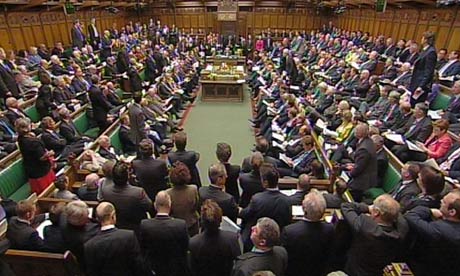 |
| A room of hated people. |
Throughout the ages, the most hated people have undoubtedly
been politicians. From Hitler to Obama, not one of them has gone without
hateful cartoons, widespread discontent, and general dislike. This has led me
to wonder, what is the perfect politician? What would his/her traits be? What
would their life story be? Having studied people’s likes and dislikes of both
humans and politicians, I’ve created a list of a few of the main features this
‘perfect politician’ would need (I’m sure I’ve missed out plenty of other
massively important traits, but this is at least a foundation).
1) They must be charming, charismatic and
interesting
Probably one of the most important features of the perfect
politician. By being charming and charismatic, they can pretty much forget
about the other important features, as they can hide the majority of their
mistakes and short-fallings behind a façade of schmoozing and flirting. I’m
pretty sure if Will Smith was a politician, his smooth, charismatic side would
be more than enough to hide any public disgrace or political corruption. What
I’m basically saying is people like Ed Miliband, David Cameron and Nick Clegg
are not quite at that standard. Obama’s not doing too badly though, the
majority of people outside America seem to believe he’s some kind of charm
idol.
2) Alongside charm, being physically attractive
It hasn’t been a
major factor, but people generally like and react better to things that are
aesthetically pleasing, I believe politicians are no different. For example,
Paul Ryan (Mitt Romney's running mate for the 2012 election) and his fan club of crazy young women, it’s no wonder the first
suggestion on Google images is this:

3) Must be around the pre-middle-aged stage
If a politician is too old, they’re considered ‘out of
touch’ by the younger generations, and yet if they’re too young they’re in
prime position to be called a ‘career politician’ or simply just be too
inexperienced to the older generations. The whole concept of age in politics is
a grey area; an area with no clear middle-ground, so I’d suggest the mid-30s as
a fair compromise for both.
4) Has worked a job in every single damned sector of employment
Including retail, catering, business, accounting, law,
authorities, arts, sport, cleaning, public services, and all the other possible
career paths. This would create a politician with no chance of being named a
career politician (although they may not be able to keep a job), and one with some
form of experience in everyone’s career, maybe even some expertise in one or
two. Their empathy would increase tenfold.
5) Perfect example of social mobility
Their preferable life story would be: Born into low income
family on benefits in council housing, somewhere surrounded by different
cultures of equally poor families, gaining understanding of everyone’s
situation by childhood friendships. Going to a low-achieving secondary school
but still achieving highly, gaining at least 3As at A2, and going to a
respectable university (but not Oxbridge, all politicians are Oxbridge). Doing
well at university and leaving with a masters, and getting a job (in every
sector mentioned in the previous point) while leading a middle class life.
Becomes a politician and hits the elite life, but still has empathy for all the
other classes. Basically they need to have this as their theme tune (just with
less explicit language, and less dick-headed-ness):
(for the iPad/iPhone users that can't see this: click here)
6) Huge racial diversity
Not only will they have had to be brought up around multiple
cultures, to cater to as many people as possible they should have mixed raced
parents, preferably with some Asian, White, Black and Oriental, to be able to
really connect with the electorate. It’s the only way.
7) Of course, not allowed any opinions that disagree with
anyone else’s
Like Jim Carrey in ‘Yes Man’, the perfect politician should
be able to please every opinion by saying yes to everyone’s opinions, even with
contradictions. When the rich ask for less tax, and the poor ask for more
taxing of the rich, they have to be able to say yes to both, somehow. Of
course, that will become much easier if they’re charming and smooth, as
mentioned in point 1.
Basically what I’m trying to say is that the perfect
politician is non-existent; impossible; there will never be one that everyone
likes (or at least that everyone agrees with) simply due to the diversity of
people and their opinions around the world. And without the perfect political
model, it’s difficult for politicians to even gain a majority of people
actually liking them. Maybe hatred just comes in the job description.


